

How to Start a Home Workout Routine
Table of Contents
- Why a Home Workout Routine Beats the Gym for Beginners
- Your Beginner Home Workout Plan: A Simple Weekly ScheduleThe 3-3-3 Rule for Starting OutWeek-by-Week Progression (Weeks 1-4)How to Know You're Ready to ProgressSession Length and Frequency
- How Many Days a Week Should Beginners Work Out?
- The 20-Minute Home Workout That Fits Any ScheduleWarm-Up, Main Set, Cool-Down
- Home Workout Equipment for Beginners: What You Actually Need
- Bodyweight Exercises and Easy Substitutions for Every Fitness LevelThe Core Five and How to Scale ThemSubstitutions for Joint Sensitivity and Limited MobilityHow to Choose a ProgressionWhen to Stop and Seek Advice
- How to Stay Consistent and Measure Progress Beyond the Scale
- Safety, Pain, and When to Stop
- Frequently Asked Questions
Last Updated: October 17, 2026
Why a Home Workout Routine Beats the Gym for Beginners
Starting a home workout routine removes the two biggest barriers beginners face: travel time and the pressure of a crowded gym floor.
At Mysfitz Market, we hear the same thing from busy professionals and parents: they want to move more, but the gym feels like a logistics problem.
The CDC physical activity guidelines recommend adults get at least 150 minutes of moderate activity per week, and a home routine makes that target genuinely reachable.
Your Beginner Home Workout Plan: A Simple Weekly Schedule
A beginner home workout plan works best when it's boringly repeatable, and then deliberately progressed. Most people fail not because the plan is too easy, but because week one is too hard and week four is abandoned. The fix is a four-week block that starts below your capacity and adds one small variable at a time.
Here's the base week you repeat for the first four weeks:
| Day | Session | Focus | Duration |
|---|---|---|---|
| Monday | Full-body strength | Squat, modified push-up, reverse lunge | 20 min |
| Tuesday | Walk | Easy cardio, conversational pace | 20-30 min |
| Wednesday | Full-body strength | Repeat Monday with slightly more reps | 20 min |
| Thursday | Rest or mobility | Gentle stretching and joint circles | 10 min |
| Friday | Full-body strength | Same movements, better form | 20 min |
| Saturday | Active fun | Hiking, cycling, or a longer walk | 30+ min |
| Sunday | Rest | Full recovery | , |
The 3-3-3 Rule for Starting Out
Three days of strength, three weeks before you add intensity, three movements per session. That's the whole rule. A common mistake is doing too much in week one and quitting by week three. Three exercises done well beats ten done badly. Master squats, modified push-ups, and reverse lunges before adding anything else.
Week-by-Week Progression (Weeks 1-4)
Progression doesn't mean adding exercises. It means adding a little work to the same movements. Use this sequence:
- Week 1, Learn the movements. 2 rounds per session, 30 seconds work / 30 seconds rest. Stop each set with 3-4 good reps left in the tank. Session length: about 15-20 minutes.
- Week 2, Add one round. 3 rounds per session, same work/rest. Session length: about 20 minutes. If week 1 left you very sore, repeat week 1 instead.
- Week 3, Add reps, not exercises. 3 rounds, 35-40 seconds work / 30 seconds rest. Keep form identical to week 1.
After week 4, repeat the block with one change: either add a fourth round, extend work intervals to 45 seconds, or add a fourth strength day if three feels automatic. Change one variable at a time so you can tell what's working.
How to Know You're Ready to Progress
Progress when you can complete all prescribed rounds with clean form and finish the session feeling like you had 2-3 reps left in reserve. If you're gasping, dizzy, or your form breaks down, hold at the current week. A common pattern among beginners is progressing too fast in weeks 2-3 and then missing a week to recover. Slower is faster here.
Session Length and Frequency
Twenty minutes is enough for weeks 1-2. By week 4, 25 minutes is reasonable. Keep strength sessions under 30 minutes for the first month, fatigue, not time, is the limiting factor. Three strength days plus two easy cardio days and one active-fun day is a sustainable beginner week; five strength days is not.
How Many Days a Week Should Beginners Work Out?
Beginners should work out three days a week for strength, plus easy movement like walking on other days. That frequency builds the exercise habit without wrecking recovery.
Consistency matters more than volume here. Three sessions you actually complete beat five you skip. Once three days feels automatic, add a fourth.
The 20-Minute Home Workout That Fits Any Schedule
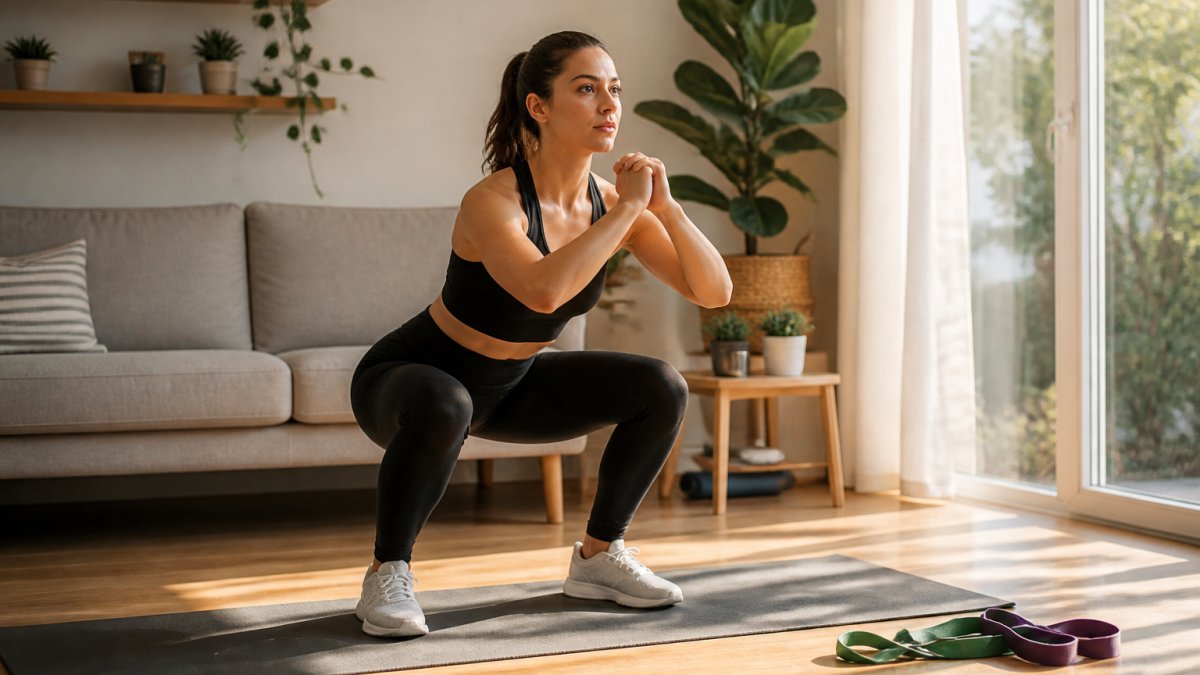
A 20-minute home workout is enough to build real strength when the session is structured. Short, focused sessions beat long, unfocused ones for beginners.
Warm-Up, Main Set, Cool-Down
Follow this template:
- Warm-up (3 minutes): arm circles, marching in place, gentle squats
- Main set (14 minutes): three rounds of squats, modified push-ups, and reverse lunges, 30 seconds each with 30 seconds rest
- Cool-down (3 minutes): stretching for quads, hamstrings, chest, and calves
If you want more variety without buying much, the 13-Piece Yoga & Pilates Set covers resistance bands, a stretching strap, and a yoga ball in one kit, which is plenty for a beginner's first few months.
Home Workout Equipment for Beginners: What You Actually Need
You need almost nothing to start: a mat, comfortable clothes, and a water bottle. Everything else is optional until you know you'll stick with it.
When you're ready to add gear, keep it small. A resistance band, a set of dumbbells, and a mat cover most beginner needs. The Compact Pilates Sliding Board is a good fit for small apartments because it stores easily and supports low-impact core and leg work.
Bodyweight Exercises and Easy Substitutions for Every Fitness Level
Bodyweight exercises are the backbone of any home routine because they need no equipment and scale to any fitness level. The key is knowing how to make each movement easier or harder without changing the movement pattern. Here's how to adjust the core five, plus substitutions for common limitations.
The Core Five and How to Scale Them
- Squats. Easier: sit-to-stand from a chair, or hold a doorframe for support. Harder: slow the descent to 3 seconds, or add a 2-second pause at the bottom. If knees complain, reduce depth to a quarter squat and widen your stance slightly.
- Modified push-ups. Easier: hands on a counter or wall. Medium: hands on a chair seat. Harder: knees off the floor, or elevate your feet. If wrists hurt, use fists or push-up handles, or switch to a standing wall push-up.
- Reverse lunges. Easier: hold a wall or chair for balance, or reduce range to a small step back. Harder: add a pause at the bottom. If balance is the issue, substitute a split squat holding support, or a step-up onto a low stair.
Substitutions for Joint Sensitivity and Limited Mobility
If a movement hurts a joint, swap the pattern rather than push through. Common swaps:
- Knee-sensitive: replace squats and lunges with glute bridges, sit-to-stands, or step-ups to a low, stable surface.
- Shoulder-sensitive: replace push-ups with wall push-ups, band chest presses, or floor press with household items.
- Low back-sensitive: replace loaded hinges with glute bridges and bird-dogs; keep core work to dead-bugs and side-lying work.
How to Choose a Progression
Use the "2-rep reserve" rule: stop each set when you could do about two more clean reps. If you can't hit the prescribed time with good form, scale down one level. If you finish easily with 5+ reps in reserve, scale up one level next session. This keeps effort in the productive range without guessing.
When to Stop and Seek Advice
Normal exertion feels like burning muscles and heavy breathing that recover within a minute or two. Warning signs are sharp pain, joint pain that persists after the session, chest tightness, dizziness, or numbness.
Accessibility matters. A grip strengthener like the Grip Strengthener Spring Grip Finger Exerciser is a low-impact way to add upper-body work while seated, and a resistance band covers most row and press substitutions without needing a rack.
How to Stay Consistent and Measure Progress Beyond the Scale
Track progress with things the scale can't see: how many push-ups you can do, how stairs feel, how your clothes fit, and how well you sleep.
Many beginners find a simple log helps. Write down reps, how the session felt, and one win per week. When motivation dips, reread it.
The NHS guidance on exercise notes that building activity gradually is key to sticking with it, and that's exactly what a logged, progressive routine does.
Safety, Pain, and When to Stop
Stop immediately if you feel sharp pain, chest tightness, dizziness, or joint pain that doesn't ease. Soreness after a session is normal; pain during one is not.
If you have a health condition, are pregnant, or haven't exercised in years, check with a doctor before starting. A brief health check is smart, not paranoid.
Frequently Asked Questions
What is the 3-3-3 rule for working out?
The 3-3-3 rule is a simple way to ease into a home workout routine: three days a week, three exercises per session, and three sets of each exercise. It keeps the commitment small enough to stick with while still building a habit. For example, you might do squats, modified push-ups, and reverse lunges on Monday, Wednesday, and Friday. Once that feels easy, add a fourth exercise or a fourth day. The point is gradual progression, not intensity on day one.
How many days a week should a beginner work out at home?
Most beginners do well with three days a week of strength training, spaced out with rest days in between. You can add light cardio like walking on the other days. Starting with two days is fine if three feels like too much. The goal is consistency, so pick a number you can actually hit for a month. Once three days feels automatic, move to four. Avoid working the same muscle groups on back-to-back days so your body has time to recover.
How long should a beginner home workout last?
A 20-minute home workout is enough for beginners. That covers a short warm-up, two or three exercises done in sets, and a cool-down. Longer sessions are not better if they leave you too sore or too tired to repeat them. Start with 15 to 20 minutes and add five minutes every couple of weeks as your fitness level improves. Consistency over months matters far more than the length of any single session.
What equipment do I need to start exercising at home?
You need very little to start. A mat, a set of resistance bands, and a sturdy chair cover most beginner exercises. A 13-piece yoga and Pilates set gives you bands, a ring, a strap, and a ball in one purchase. Add a compact Pilates sliding board if you want low-impact full-body work in a small space. Skip the treadmill and the heavy dumbbells until you know your routine will stick. Bodyweight exercises alone can carry you for the first month.
How can I stay consistent with a home workout routine?
Schedule workouts like appointments and put them on your calendar. Lay out your clothes and equipment the night before. Pick a time that fits your real life, whether that is 6 a.m. before the kids wake up or 9 p.m. after they go to bed. Track each session with a simple checkmark on a calendar. Missing one day is fine; missing two in a row is what breaks the habit. Keep sessions short enough that you never dread them.
What is a good beginner workout routine at home?
A good beginner routine hits all major muscle groups with simple movements. Try squats, modified push-ups, reverse lunges, calf raises, and a plank hold. Do two or three sets of 8 to 12 repetitions for each. Add a five-minute warm-up with arm circles and marching in place, then finish with stretching. Do this three days a week with rest days between. After two weeks, add one new exercise or one extra set to keep progressing.
Building a routine is the easy part. Staying with it takes the right setup, and that's where Mysfitz Market helps. We stock fitness essentials like resistance sets, core trainers, and grip tools alongside everything else your home needs, all in one place with multi-currency support for international shoppers. Get started with Mysfitz Market and build a home workout routine you'll actually keep.