

How to Choose Quality Online Products
Table of Contents
- What to Check Before Buying OnlineVerify seller credibility and reputationExamine product descriptions and images
- How to Spot Fake Product Reviews and Manipulated RatingsRed flags in review patternsChecking review authenticityPlatform-specific checks
- How to Compare Products Online for Best ValueFeature and specification comparisonTotal cost evaluationSeller verification and consumer protection
- Build Your Online Shopping Checklist
- Common Shopping Mistakes to Avoid
- Frequently Asked Questions
Last Updated: October 18, 2026
What to Check Before Buying Online
Before you click purchase, take five minutes to verify what you're actually buying, the foundation of how to choose quality online products. Most shoppers skip this step and regret it later.
Start by examining the product description carefully. Read every word. Manufacturers often hide important details in the fine print. Look for material composition, dimensions, weight, and care instructions. If the description is vague or missing key specs, that's a red flag.
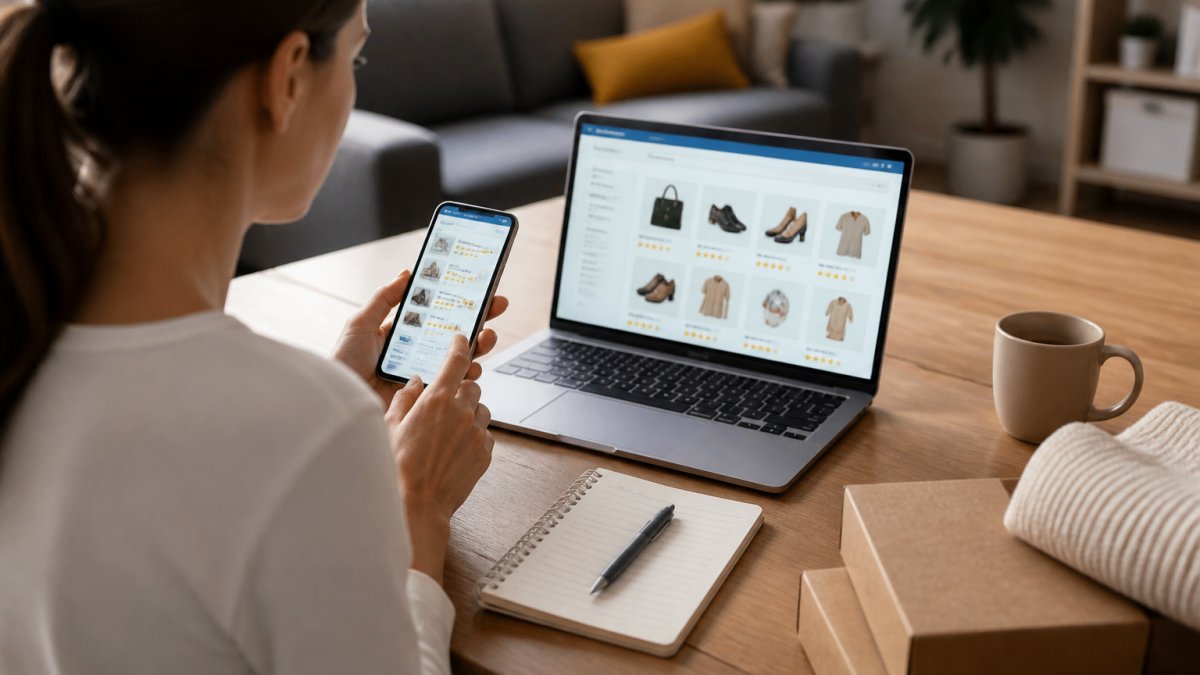
Next, study the product images. High-quality visuals matter because they're your only window into what you're getting. Look for multiple angles, close-ups of materials, and lifestyle shots showing the item in use. Blurry photos or stock images suggest the seller didn't invest in presentation.
Verify seller credibility and reputation
The seller matters as much as the product. Check their store ratings and how long they've been in business. Look for a physical address, contact information, and customer service options. Established sellers typically display these details prominently because they're proud of their track record.
Read the return policy before buying. Reputable sellers offer clear refund terms, reasonable timeframes, and transparent shipping costs for returns. If the policy is buried, unclear, or nonexistent, move on. A business that won't stand behind its products isn't worth your money.
Examine product descriptions and images
Product descriptions should answer your questions before you ask them. They should explain what the item does, who it's for, and why someone would buy it. Generic descriptions like "high quality" or "great for everyone" lack substance. Specific descriptions mention brand names, certifications, or performance metrics.
Images reveal quality faster than words. Compare products across different sellers. Notice the difference between professional photography and rushed snapshots. Sellers who invest in good photos usually invest in good products too. Count the images available. More angles mean more transparency.
How to Spot Fake Product Reviews and Manipulated Ratings
Fake reviews are everywhere online, and they are getting harder to spot. Learning the actual mechanisms sellers and review farms use protects your wallet and your time far better than scanning for "sounds fake" vibes.
Red flags in review patterns
Watch for reviews that all sound identical. Genuine customers use different words and mention specific details about their experience. Fake reviews often reuse the same phrases, follow the same sentence structure, or praise only the product without ever mentioning a drawback.
Check the timing of reviews. If a product gets dozens of five-star reviews posted within days of launch, that's suspicious. Real customers discover products gradually. A sudden spike in positive reviews suggests manipulation. Look for clusters: multiple reviews posted within the same 24-48 hour window, especially on a brand-new listing, are a common pattern in review farms.
Look at reviewer profiles. Do they have a history of reviews across different products, or did they appear just to review this one item? Legitimate reviewers typically have established patterns. New accounts with only one review deserve skepticism.
Checking review authenticity
Read the middle-star reviews first. One-star and five-star reviews often represent extreme experiences. Three and four-star reviews tend to be more balanced and realistic. These reviewers usually mention both strengths and weaknesses, and they tend to include specifics like sizing, fit, durability after weeks of use, or how a product performed under a particular condition.
Search for specific complaints. If multiple reviewers mention the same issue, it's probably real. If you see vague complaints ("didn't work," "poor quality") without detail, they're likely fake. Conversely, a single detailed complaint about a specific failure mode, a zipper that broke after two weeks, a battery that stopped holding charge, is more credible than ten generic five-star raves.
Cross-reference reviews across platforms. If a product has five stars on one site but two stars elsewhere, something's off. Check independent review sites and forums where people discuss products honestly without seller control.
Platform-specific checks
Different platforms expose different signals. On Amazon, check the "Customers say" AI summary and the review histogram, a product with a bimodal split (many 5s and many 1s, few 3s) often signals either a polarizing product or review manipulation. On Etsy and eBay, seller feedback is tied to transactions, so look at feedback left for the seller as a buyer, not just as a seller. On standalone brand sites, be wary of on-site reviews that lack any verified-purchase badge or third-party review platform integration.
A useful cross-check: search the product name plus the word "review" on a general search engine and look for independent coverage from outlets that disclose how they obtained the product. If the only reviews you can find are on the seller's own site, treat the rating as marketing, not evidence.
How to Compare Products Online for Best Value
Choosing quality means comparing more than price. The most useful comparison framework has two layers: category-specific quality criteria and a true total-cost calculation.
Feature and specification comparison
List the features that matter to you. Don't compare everything; focus on what you actually need. Then apply category-specific criteria, because "quality" means different things in different product types:
- Electronics: check the warranty length and what it covers, battery capacity and whether it's user-replaceable, port and protocol standards (e.g., USB-C Power Delivery wattage, HDMI version), and whether the manufacturer publishes firmware update commitments. A device with a one-year warranty and no update history is a different risk than one with a two-year warranty and documented updates.
- Clothing: check fiber content percentages (not just "cotton" but "95% cotton, 5% elastane"), whether sizing charts include garment measurements rather than body measurements, care instructions (machine-washable vs. dry-clean-only affects lifetime cost), and whether the seller lists country of manufacture and fabric weight.
- Household goods: check material grade (e.g., 18/10 vs. 18/0 stainless steel), whether replacement parts are sold separately, dimensions and weight capacity with tolerances, and whether the item is rated for the use you intend (dishwasher-safe, heat-resistant to a stated temperature).
Check specifications carefully. Two products might look similar but differ in materials, dimensions, or performance. Read the fine print. A "water-resistant" item is different from "waterproof." A "fits up to 100 pounds" is different from "rated for 100-pound loads." When a spec is missing, treat that as a data point: a seller who omits a dimension or material is often hiding a weakness rather than forgetting to mention it.
Total cost evaluation
Price isn't just the sticker amount. Build a true total-cost comparison by adding these line items for each candidate product:
- Sticker price, the listed price before tax and shipping.
- Shipping and handling, including any threshold you'd need to cross for free shipping.
- Tax, estimate your local rate; it applies to most online purchases.
- Required accessories or consumables, cables, filters, replacement blades, batteries, or proprietary pods. A cheap printer with expensive ink is a classic example.
- Warranty and expected repair cost, a longer warranty has real value; a product with no warranty shifts repair risk to you.
- Return shipping cost, if the seller charges for returns, factor in the probability you'll return it.
- Durability and cost per use, estimate how long the product will last and divide total cost by expected uses.
Consider durability explicitly. A product that costs more but lasts twice as long offers better value. Calculate the cost per use over time. That expensive fitness item used five days a week for two years costs less per use than a cheap version used twice and abandoned.
Seller verification and consumer protection
Before you commit, verify who you're actually buying from. Look for a physical business address, a working customer-service phone number or email, and a clear legal entity name in the site footer or marketplace seller profile.
Confirm payment security: checkout should use HTTPS, and you should pay with a method that offers dispute rights (major credit cards and established payment platforms generally provide chargeback or buyer-protection processes). Avoid direct bank transfers or gift-card payments to unknown sellers, these are common in scams because they offer little recourse.
Finally, read the return and refund policy for the specific terms that matter: the return window length, who pays return shipping, whether returns are accepted for opened items, and whether refunds are cash or store credit. A policy that looks generous at a glance can be narrow in practice.
Build Your Online Shopping Checklist
Use this checklist before making any purchase:
Common Shopping Mistakes to Avoid
The biggest mistake is rushing. Impulse purchases lead to returns and wasted money. Take time to verify what you're buying.
Don't rely on a single review. One person's experience doesn't represent everyone's. Read multiple reviews from different types of reviewers to get a balanced picture.
Avoid assuming cheaper is better. Low prices sometimes indicate low quality, not smart deals. Compare what you're actually getting for the money.
Don't ignore seller credibility. Buying from an unknown marketplace with no customer service puts you at risk. Established sellers have reputations to protect.
Never skip the return policy. A great product becomes a problem if you can't return it. Know your options before you buy.
Choosing quality online products takes practice, but the process becomes faster with experience. Our curated selection focuses on quality across clothing, jewelry, fitness gear, pet supplies, and more.
Frequently Asked Questions
How can you tell whether online product reviews are trustworthy?
Trustworthy reviews often include specific details about the product's performance, materials, or how it fits. Look for a mix of positive and negative feedback. Be skeptical of reviews that are extremely short, use identical language, or come from newly created accounts. Check the reviewer's history, do they review many products or just one? Authentic reviewers usually have verified purchase badges and varied review histories. Independent reviews from established sites often provide more reliable assessments than seller-hosted reviews alone.
What should you check about a seller before placing an order?
Verify the seller's return and refund policy before buying. Check how long they've been operating and look at their overall rating across multiple platforms. Read recent customer feedback about shipping times and product condition on arrival. Confirm they have clear contact information and customer service channels. For international orders, check shipping costs and delivery timeframes to your location. Look for security badges and verify the website uses secure checkout (HTTPS). A legitimate seller makes their policies transparent and easy to find.
What should you check in a return policy before buying online?
Before purchasing, confirm the return window (ideally at least 30 days). Verify who pays for return shipping, some sellers cover it, others don't. Check if there are restocking fees or conditions on returns (unused items only, tags attached, etc.). Understand the refund timeline: when will your money be returned after the item arrives? Look for hassle-free return processes that don't require extensive documentation. A strong return policy protects you if the product doesn't meet expectations or arrives damaged. This is especially important for items like clothing, fitness equipment, or pet products where fit and quality matter.
How can you avoid low-quality products when shopping online?
Start by comparing products across multiple sellers and categories. Look for items with consistent positive feedback and specific performance details in reviews. Check product materials, certifications, and durability claims. Compare prices, extremely cheap items often signal lower quality. Read the full product description for warnings or limitations. Verify seller credibility and return policies before committing. For specialized items like fitness gear or pet supplies, prioritize established brands or sellers with strong track records. Build trust gradually by starting with smaller purchases before buying higher-value items from new sellers.